Faster customer onboarding with minimal manual effort
Improved security and tenant isolation
New recurring revenue through subscription models
Results depend on scope, integrations and adoption.
The operating context
A clearer view of the whole operation.
An Odoo deployment can support internal operations for years before the business decides to sell the application to external customers. That shift changes the product requirements: each customer needs an appropriate data boundary, repeatable environment setup, controlled access, onboarding, and a way to manage recurring subscriptions. Turning Odoo into a SaaS offering therefore requires more than enabling multiple companies or hosting several databases. It requires an operating model for the customer lifecycle.
Where friction builds
Adding customers is still an implementation task, not a repeatable SaaS workflow.
Each new customer needs database setup, configuration, access, and billing work. Separate environments can multiply upgrade, support, and monitoring tasks.
Shared company records or custom access rules may not provide the tenant boundaries your product requires. As sign-ups grow, onboarding and operations become harder to manage.
Current approach
Create separate Odoo databases manually for customers
Use multi-company configuration for customer separation
Host individual Odoo instances for each subscriber
Manage onboarding and subscriptions through separate tools
Operational impact
Creates performance bottlenecks
Increases operational overhead
Leads to security and data isolation risks
Slows down customer onboarding
Limits scalability and growth potential
Inside the solution
The capabilities behind the operation.
Review the functional scope, then discuss the requirements specific to your team.
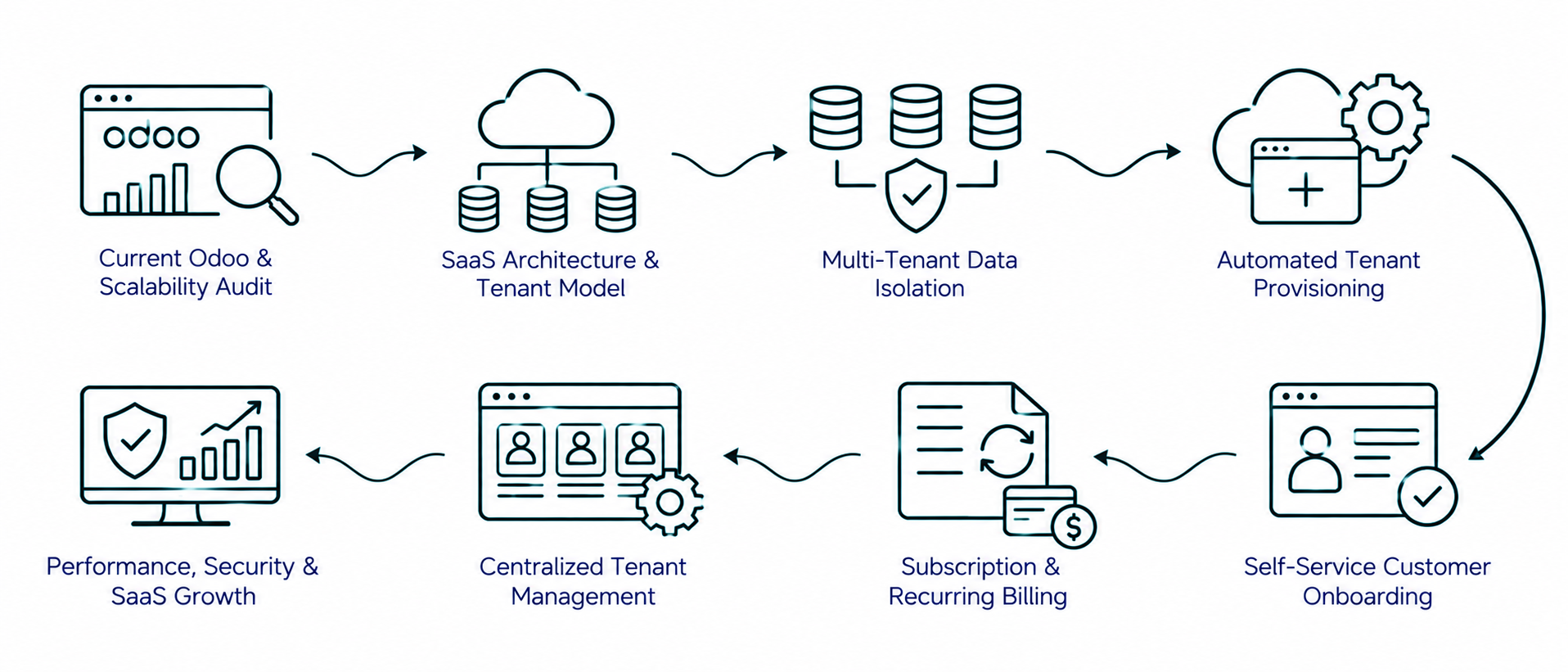
Multi-Tenant Architecture and Data Isolation
Design the customer tenancy model around data separation, customization requirements, expected growth, and operating costs. Depending on the product, the architecture may use separate Odoo databases or a shared database with carefully enforced tenant-aware access controls.
Automated Tenant Provisioning
Automate the creation and configuration of customer environments instead of requiring repeated manual Odoo setup. Define a standardized provisioning workflow for new tenants, including the required environment configuration and application setup.
Subscription and Billing Integration
Connect the SaaS subscription workflow with payment and billing systems. Support integration options such as Stripe, Razorpay, PayPal, or custom billing engines according to the product's payment requirements and subscription model.
Self-Service Customer Onboarding
Build an onboarding workflow that allows customers to register and begin using the platform without requiring manual intervention for every new account. Connect registration with the agreed tenant creation, configuration, and access process.
Performance Optimization and Scalability
Review application and infrastructure performance as multiple customer environments and workloads grow. Identify bottlenecks and optimize the agreed architecture to support tenant workloads, platform stability, and future expansion.
Centralized Tenant Management
Provide a central administration interface for managing customer environments and tenant operations. Give authorized administrators a consolidated view of the customers and environments managed by the SaaS platform.
PySquad reviews your existing Odoo version, custom modules, data structure, hosting setup, integrations, and customer workflows before recommending a migration path. We design the tenancy model around isolation requirements, customer-specific configuration, expected growth, and operating costs.
How it connects
The complete workflow, in one view.
Make an informed decision
Is this the right fit?
The right solution starts with the right operating requirements.
What affects the cost and timeline of an Odoo SaaS migration?
Scope depends on existing custom modules, number of tenants, data to migrate, provisioning rules, billing events, payment providers, and hosting requirements. PySquad supports integration options including Stripe, Razorpay, PayPal, and custom billing engines, subject to project assessment. A realistic estimate requires an architecture and dependency review first.
Can an existing Odoo ERP be converted into a SaaS platform?
Many customized Odoo systems can be extended into SaaS products, but feasibility depends on the current modules, custom code, data model, hosting setup, integrations, and customer access requirements. PySquad should assess what can be retained, what needs redesign, and whether Odoo remains the right foundation.
Should we use a shared database or a separate database for each SaaS customer?
There is no universal choice. Separate databases can provide clearer customer boundaries and per-tenant backup or customization, but increase provisioning and upgrade work. Shared databases can reduce operational overhead, but require strict tenant-aware access controls and testing. The choice depends on isolation, scale, customization, and cost.
Is Odoo multi-company functionality enough to create a multi-tenant SaaS product?
Not by itself. Odoo multi-company supports multiple related companies within one database and allows some data to be shared. A SaaS product needs customer-specific identity, access, data boundaries, onboarding, and lifecycle controls. Those requirements must be designed and tested separately.
Will migrating our existing Odoo customers into a SaaS platform disrupt their current operations?
A migration plan should identify existing customer databases, records, custom modules, integrations, and data relationships before cutover. PySquad can plan staged validation and a controlled rollout around the agreed scope. Disruption cannot be ruled out without reviewing the current environment and dependencies.
Start with your requirements
Let’s define your next step.
Tell us what needs to work better, the systems you use, and the scope you have in mind.