More predictable engineering and release workflows
Clearer visibility into technical risks and priorities
Better alignment between engineering work and business goals
Results depend on scope, integrations and adoption.
The operating context
A clearer view of the whole operation.
A validated MVP proves that a product can solve a problem, but it does not establish that its architecture, infrastructure, and engineering workflows will support continued growth. As customers, data, and product requirements increase, early shortcuts can lead to performance bottlenecks, riskier releases, and mounting technical debt. Startup scaling services help founders and engineering leaders prioritize improvements to an existing product while continuing to develop features customers need.
Where friction builds
Your MVP Works, but Its Engineering Foundation Is Holding You Back
An MVP built for speed can struggle as users, data, and integrations increase. Performance bottlenecks, fragile deployments, and technical debt make every new feature harder to deliver.
Founders must balance roadmap commitments against reliability, security, and architecture improvements. Without clear priorities, both product delivery and technical confidence can suffer.
Current approach
Continue adding features to the existing codebase
Postpone architecture improvements until problems emerge
Fix performance bottlenecks only after incidents
Depend on founders for every technical decision
Operational impact
Growing code complexity makes changes harder to test and maintain
Delayed architecture work increases the risk of disruptive changes later
Assess the existing codebase, architecture, performance, infrastructure, and release process
02
Identify the highest priority reliability, scalability, and engineering risks
03
Align technical improvements with product goals and business constraints
04
Plan implementation around dependencies, risk, and ongoing feature commitments
05
Implement and validate prioritized changes incrementally
06
Review progress and refine the next engineering priorities with your team
Our approach
PySquad works alongside your team to identify the engineering constraints affecting your existing product. We prioritize architecture stabilization, performance improvements, infrastructure needs, security controls, and release workflows according to your business requirements. Changes are implemented incrementally to balance system improvements with ongoing product delivery. The engagement focuses on the risks and priorities identified in your current environment rather than assuming a complete rebuild is
How it connects
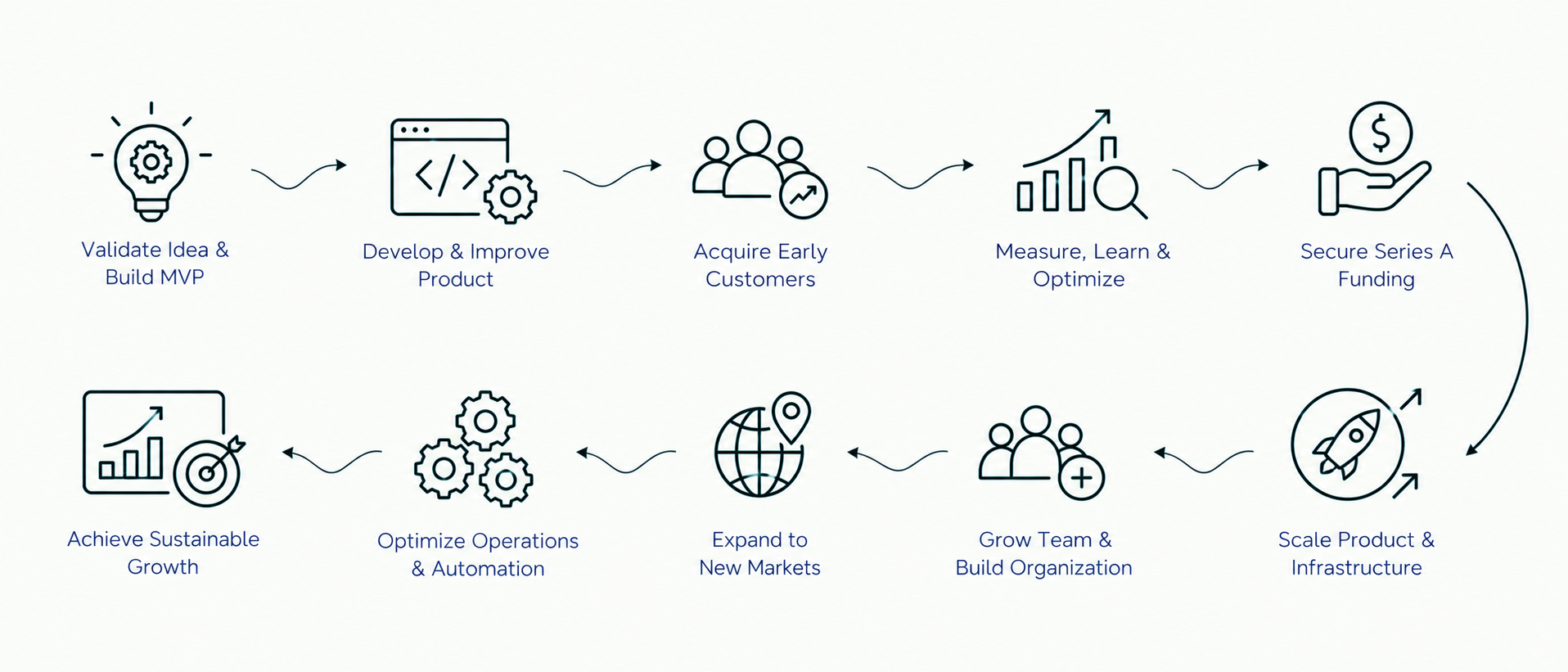
The complete workflow, in one view.
Make an informed decision
Is this the right fit?
The right solution starts with the right operating requirements.
What are startup scaling services, and when should we use them?
Startup scaling services help improve an existing software product as user activity, data volume, and business requirements increase. They are relevant when an MVP has validated demand but performance, architecture, release reliability, or technical debt begins to constrain development. The starting point should be an assessment of your product's actual engineering risks.
How can we prepare our software for Series A or larger enterprise customers?
Start by identifying technical risks related to reliability, performance, architecture, security, and engineering delivery. The priorities will vary by product, customer requirements, and business model. PySquad's service can address relevant engineering improvements, but it cannot guarantee funding, enterprise approval, or compliance certification without the specific requirements and evidence being established.
Should we rebuild our MVP or improve the existing codebase?
The decision depends on the condition of the existing architecture, the severity of technical constraints, and the cost and risk of changing it. A focused assessment can identify whether targeted refactoring, performance optimization, infrastructure changes, or a broader redesign is justified. A complete rebuild should not be assumed before evaluating the current product.
Can PySquad improve our software while our team continues shipping features?
Yes. The stated service approach is to work alongside your team and implement improvements incrementally. The practical plan depends on the current architecture, release process, engineering capacity, and severity of the problems. Prioritizing changes around product commitments helps the team address technical risks without automatically stopping ongoing development.
What does a startup scaling engagement include?
The service can cover architecture stabilization, performance optimization, CI/CD workflows, security and access controls, infrastructure design, and engineering process improvements. The appropriate scope depends on your current product and business priorities. Before starting, align on the assessment findings, implementation priorities, dependencies, acceptance criteria, and responsibilities of each team.
Start with your requirements
Let’s define your next step.
Tell us what needs to work better, the systems you use, and the scope you have in mind.