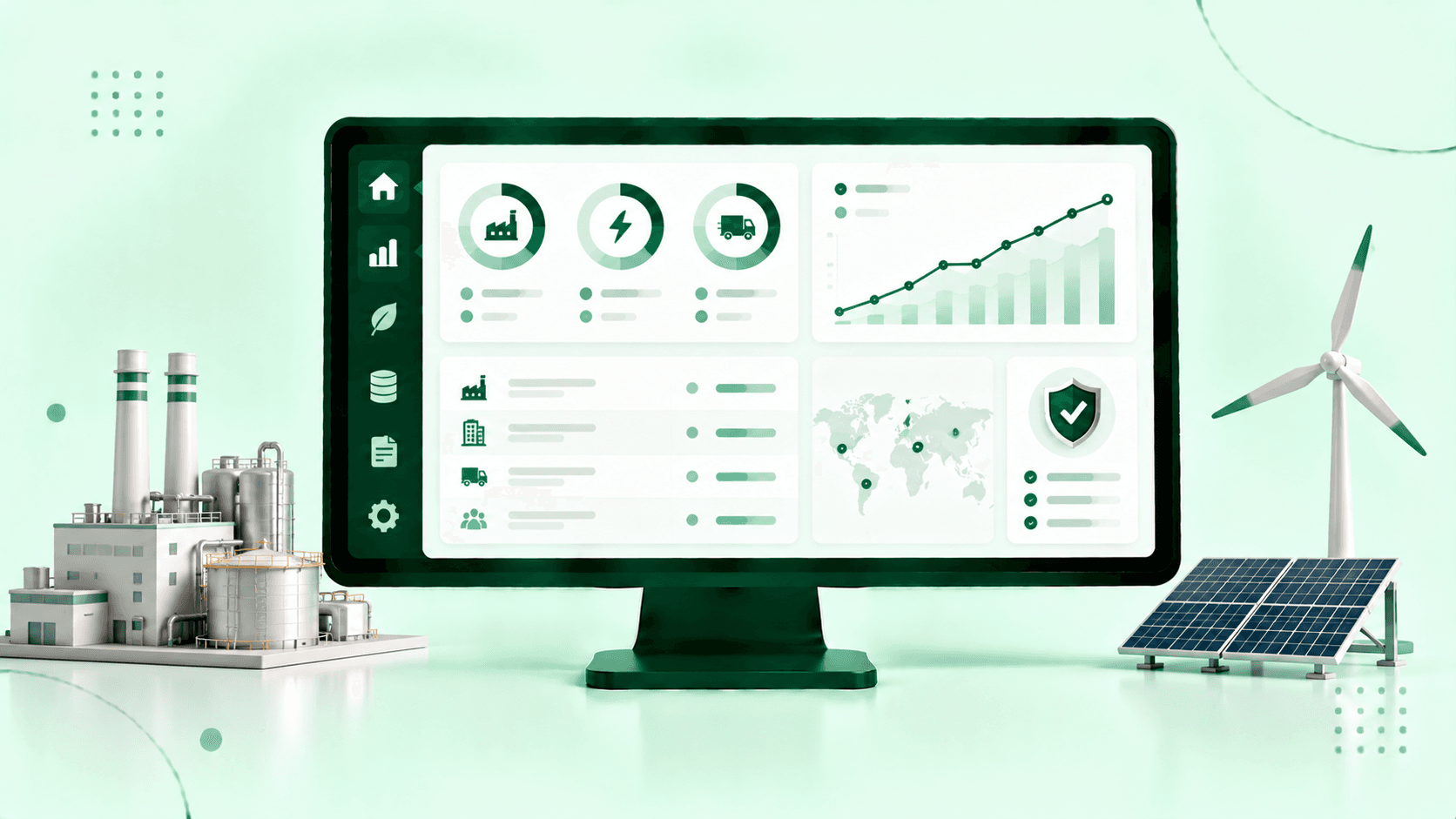
Climate data management platform for enterprises to collect, structure, audit, and analyze emissions, climate risk, and sustainability data across operations.
Results depend on scope, integrations and adoption.
The operating context
A clearer view of the whole operation.
Enterprises collect climate and sustainability data from energy systems, procurement, suppliers, facilities, finance, spreadsheets, and external sources. When these inputs use different formats, ownership rules, and calculation methods, reporting becomes slower and harder to validate.
Where friction builds
Why enterprise climate data stays fragmented
Climate reporting is not only a reporting problem. Organizations must know where each number came from, which methodology was applied, who approved it, and how the value changed over time. Without clear lineage and standardized calculations, teams spend reporting cycles reconciling data instead of analyzing it.
The complexity grows across multiple facilities, entities, suppliers, and regions. A useful climate data platform should centralize collection, calculation logic, approvals, lineage, and reporting without assuming that every source is automatically complete or accurate.
Current approach
Manage climate data in spreadsheets
Collect data during reporting cycles
Rely on manual calculations
Separate climate data from operations
Operational impact
Data lineage becomes unclear
Validation takes too long
Reporting remains highly manual
Decision-making lacks trusted inputs
Inside the solution
The capabilities behind the operation.
Review the functional scope, then discuss the requirements specific to your team.
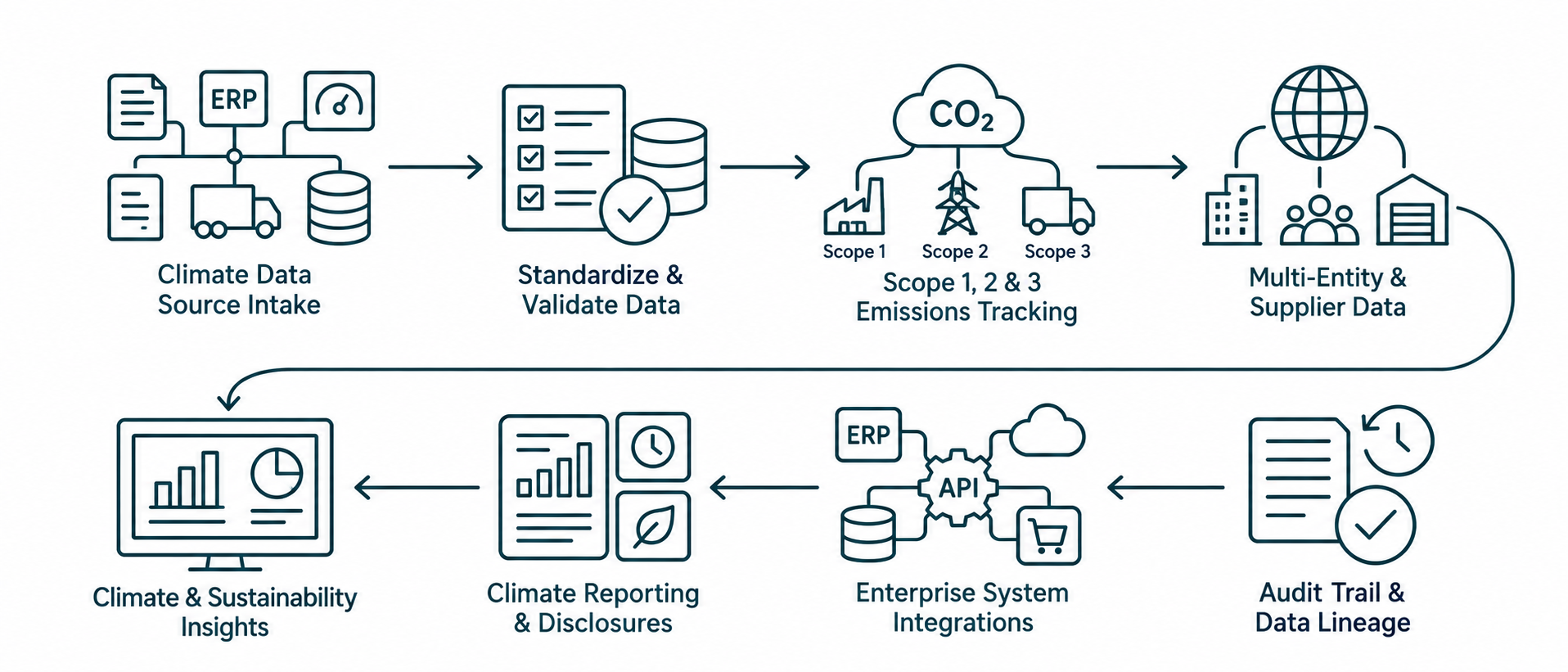
Centralized Climate Data Repository
Maintain a single source of truth for emissions, energy usage, and climate-related data.
Structured Emissions Tracking
Capture Scope 1, 2, and 3 emissions with clear calculation logic and source mapping.
Audit and Traceability Framework
Provide full data lineage, approvals, and change history for audit readiness.
Multi-Entity and Supplier Data Support
Collect and manage climate data across business units, regions, and supply chains.
Analytics and Reporting Layer
Generate insights and export-ready reports for disclosures and decision-making.
Integration with Enterprise Systems
Connect with ERP, procurement, and energy systems for continuous data flow.
We design climate data platforms around structured data models, calculation transparency, source lineage, ownership, approvals, and enterprise integration rather than treating sustainability reporting as a standalone dashboard exercise. By connecting emissions, energy, supplier, and operational data with controlled calculation and review workflows, teams gain a more consistent foundation for disclosures, internal analysis, audits, and ongoing climate decision-making.
How it connects
The complete workflow, in one view.
Make an informed decision
Is this the right fit?
The right solution starts with the right operating requirements.
A climate data management platform centralizes emissions, energy, supplier, operational, and sustainability data so organizations can manage calculations, ownership, approvals, lineage, reporting, and analysis in a more structured way.
Can the platform manage Scope 1, Scope 2, and Scope 3 emissions data?
Yes. It can structure activity data, emission factors, calculation methods, source references, and resulting emissions across defined reporting scopes. The quality of the output still depends on the quality of the underlying source data and methodology.
How does climate data lineage work?
Data lineage records where a value came from, how it was transformed or calculated, which factors or assumptions were used, who changed or approved it, and how the value evolved over time. This makes reported figures easier to review and investigate.
Can the platform collect climate data from ERP, procurement, energy, and supplier systems?
Yes, when suitable APIs, files, databases, or integration methods are available. Enterprise systems can provide activity data such as purchasing, fuel use, electricity, logistics, supplier information, or other operational inputs used in climate calculations.
Does climate data management software replace carbon accounting or ESG reporting tools?
Not necessarily. A climate data management platform can serve as the governed data foundation underneath carbon accounting, sustainability reporting, analytics, or disclosure workflows. Whether it replaces another tool depends on the organization’s calculation, disclosure, workflow, and integration requirements.
Start with your requirements
Let’s define your next step.
Tell us what needs to work better, the systems you use, and the scope you have in mind.